Gender Evidence for Better Groundwater Governance
Who participates in decisions about water governance? Whose perspectives are represented when priorities are set? And how can water institutions ensure that governance processes reflect the communities they serve?
These questions were discussed around World Water Day 2026, at the launch of UNESCO’s World Water Development Report 2026, titled “Water for all people: equal rights and opportunities”. DIKTAS II national expert Lidija Brnović contributed a regional perspective from the Dinaric Karst Aquifer System, drawing on the project’s gender analyses to underline a practical need: stronger evidence to support decision-making that is both effective and inclusive in complex, transboundary groundwater systems.
To help build that evidence, DIKTAS II project carried out national gender analyses in Albania, Bosnia and Herzegovina, Croatia and Montenegro. Together, they explore how gender intersects with groundwater governance and water-related decision-making and help identify both shared patterns and country-specific realities across the region.
How DIKTAS II project looks at gender and water
To better understand how gender influences water governance, the analyses examined water through three interconnected dimensions: water as an asset, water as a service, and water as a space for participation and decision-making.
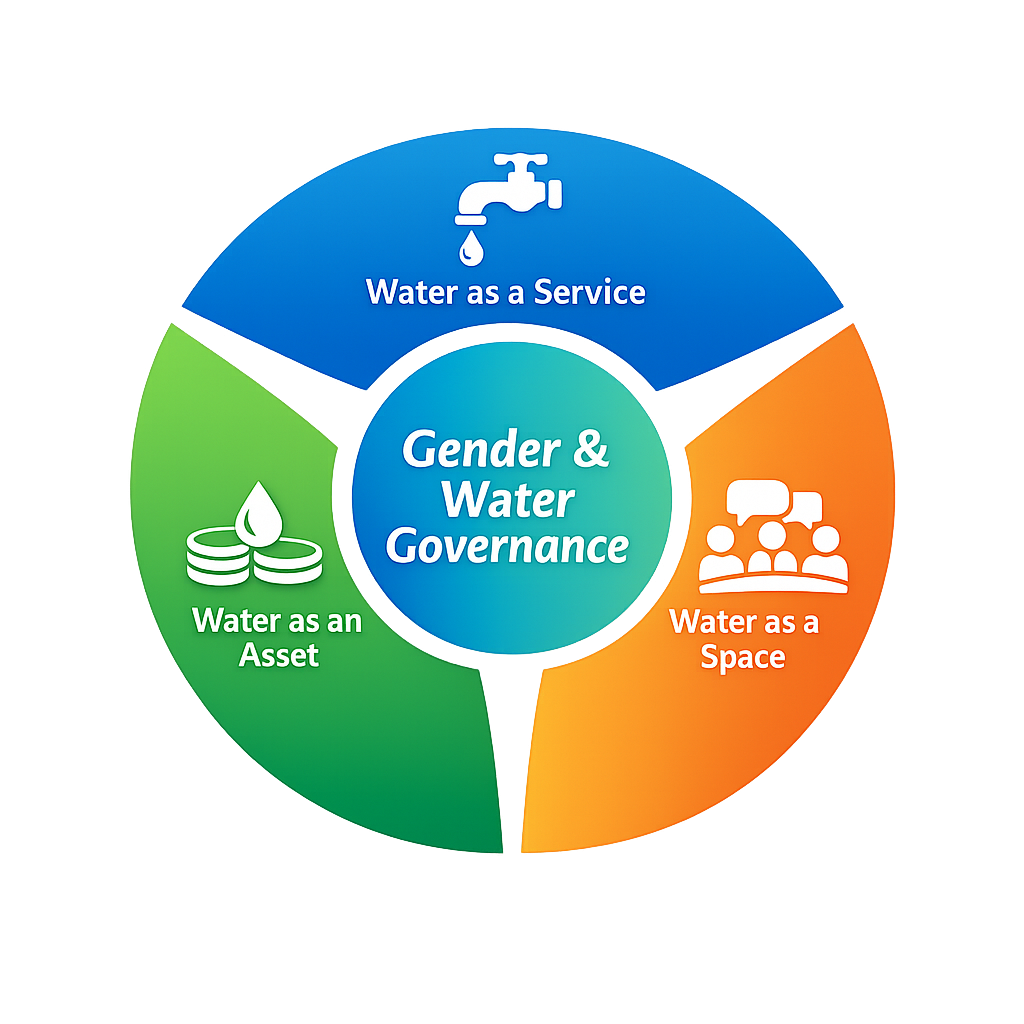
Caption: Analytical framework used by the DIKTAS II gender analyses to examine the links between gender, water governance and decision-making across the Dinaric Karst region.
This approach made it possible to look beyond water infrastructure and resource management alone. It considered how women and men may experience water-related opportunities and responsibilities differently, how they access and benefit from services, and how they participate in the institutions and processes that shape water governance.
Lidija Brnović also emphasized that water is a fundamental human right and a key component of Sustainable Development Goal 6. She noted that access to, control over and management of water can be shaped by gender norms and power relations, making gender analysis an important tool for understanding whose needs are reflected in water governance.
What the analyses found
While national contexts differ, three common themes emerged across the region.
1. Policy commitments exist, but implementation remains uneven
Across the region, legal and policy frameworks supporting gender equality are generally well established. A recurring finding, however, was that translating these commitments into consistent institutional practice remains a challenge.
Across countries, the analyses point to gaps between frameworks and day-to-day implementation — shaped by factors such as institutional capacity, available resources, coordination mechanisms and long-term follow-through.
For groundwater governance, this may influence how equality objectives are reflected in routine procedures, priorities and decision-making processes. Gender-responsive budgeting also remains limited or only partially applied across parts of the region, meaning that equality commitments are not always matched with the resources needed for implementation.
2. Better data is needed to support decision-making
A second recurring theme was the limited availability of gender-disaggregated data related to employment in the water sector, women’s participation in technical and decision-making roles, access to water-related assets, use of agricultural land and participation in local consultation processes.
In many cases, such information remains unavailable, outdated or difficult to compare across institutions and sectors.
This reflects a broader challenge also highlighted in the World Water Development Report 2026, which notes that gaps in sex-disaggregated water data continue to undermine evidence-based decision-making globally.
These information gaps make it more difficult to assess progress, identify inequalities and design evidence-based responses. They may also limit the ability to understand participation patterns or evaluate whether existing measures are achieving their intended outcomes.
Strengthening the collection and use of gender-disaggregated information was therefore identified as an important area for future improvement across the region.
3. Representation and participation remain important challenges
The studies also examined participation in water governance structures and decision-making processes, including representation within technical, managerial, and leadership roles.
While the situation varies among countries, the analyses point to continuing barriers to full participation in some areas of water governance. These may include underrepresentation in technical and leadership positions or situations where formal participation does not necessarily translate into meaningful influence over decisions.
At the same time, the DIKTAS II studies also identified examples of progress, demonstrating that positive change is possible when institutional commitments are supported by concrete measures and sustained efforts. In this context, ensuring that participation translates into meaningful influence remains an important consideration for inclusive governance.
Why this matters for groundwater governance
Drawing on the findings of the analyses, Lidija Brnović emphasized during the UNESCO discussion that stronger gender-disaggregated data and targeted approaches are essential for understanding how water challenges can affect women and men differently — and for supporting decision-making that reflects diverse needs and experiences.
The DIKTAS II gender analyses highlight that groundwater governance is shaped not only by hydrological and technical considerations, but also by the institutions, processes and stakeholders involved in managing shared resources.
Understanding who participates, whose perspectives are represented, and what information is available to support decisions contributes to a more complete picture of how governance systems function. The analyses therefore provide valuable insights for strengthening groundwater governance across the Dinaric Karst region.
Building a regional evidence base
One of the strengths of the DIKTAS II gender analyses is that they combine national perspectives with a regional outlook. By identifying both shared challenges and country-specific circumstances, the studies help build a stronger evidence base for future dialogue, policy development and capacity-building efforts.
The regional analysis also points to an emerging area that deserves further attention: the links between water governance, climate vulnerability and gender-based violence. While evidence from the Western Balkans remains limited, the report notes that global research highlights potential connections between unreliable water services, climate-related pressures and existing inequalities, particularly in rural and remote communities.
As discussions on gender and water continue internationally, the findings generated through DIKTAS II contribute regional evidence and practical insights that can help inform more inclusive and effective groundwater governance across the Dinaric Karst region.